MAESTRO'S MUSICAL FAMILY
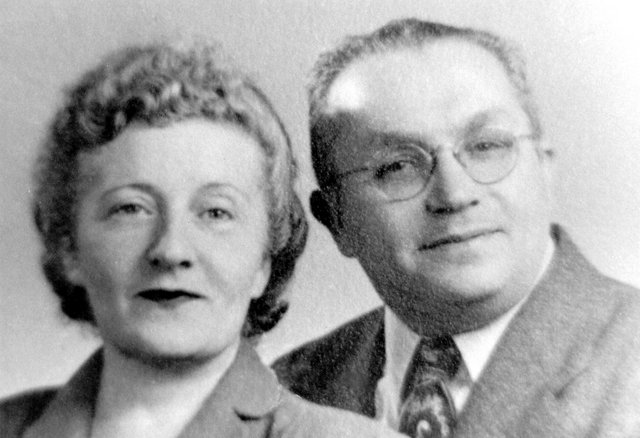
Photo Album
The Family of Mischa and Maria (Drobatschewsky) Borisoff
Photo Gallery
149 Family Photos
Slide Show
Presentation
Annotated with Names and
Information

Click Picture above and listen to a rare WWII
recording that Bob Borisoff sent to his family.
This record was sent courtesy of the Red Cross, from a hospital in San
Francisco, where Bob was
recovering
from injuries he sustained during an accidental depth-charge mine detonation.
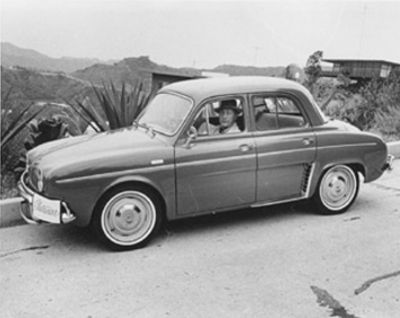
Circa 1969...The Heifetz Electric Car was designed and built for Jascha Heifetz by Bob Borisoff, PE. Mr. Heifetz traveled from home to Hollywood. The car did 45 mph for 45 to 70 miles depending on how he conserved the energy. (Allegro ma non troppo!)
Ride with Joe Pyne,
reporter Al Wyman and my father in the Heifetz's Electric Car (1969).The car
was a converted Renault Dolphin fully electrified with 12, 6 volt lead acid
batteries.
A ride in Mr. Heifetz's Electric Car
(click picture above for film clip)
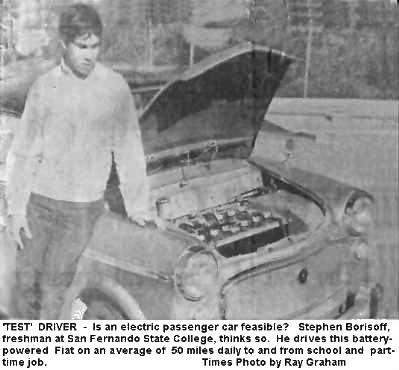
Read the article from
the L.A. Times about a second 1970 electric car.
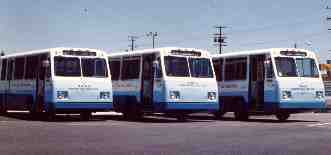
Read "15 Years Before Its Time,"... The complete history of Borisoff Engineering's, "Electrobus," an all-electric rapid transit vehicle. (Pages 14-27)
Update: Bob Borisoff passed away, June 5th, 2021, a
month short of his 96th birthday.
The
Biography of Maria Borisoff...
Family Birth Records from Odesssa
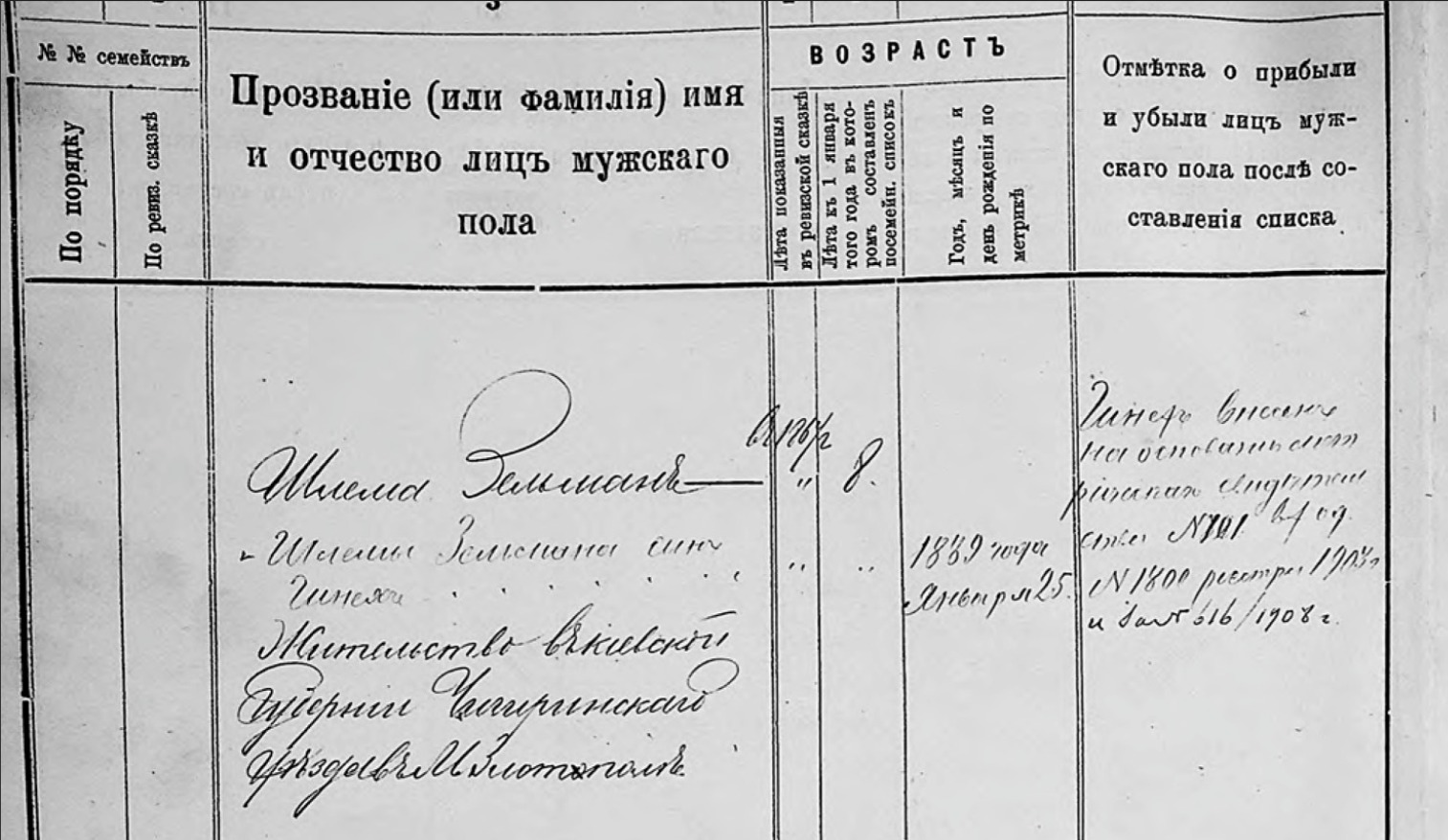
Shlema (Solomon) Zelman (Sonya Fidelman's
(aka Fiedemann)
husband) was born in 1867. His son Genich (aka Heinrich) was born on January 25th, 1889
based on his metric record. According to this documents Shlema Zelman's wife was Sonya...
click above
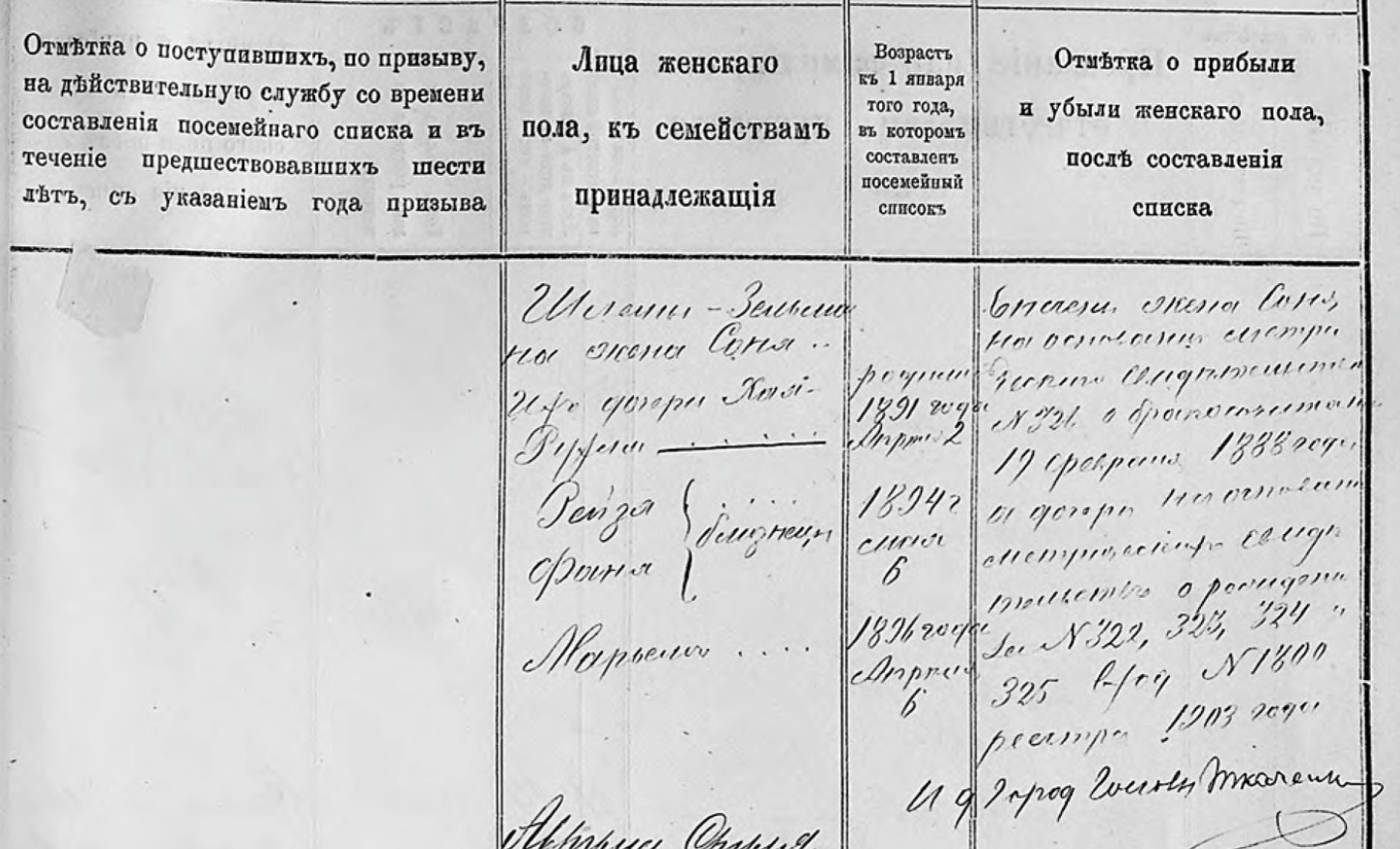
Their daughters were:
Khaya-Rokhl (April 2nd, 1891)
Twins Reisa and Fenya (May 6th, 1894)
Maryam (April 6th, 1896)
click above
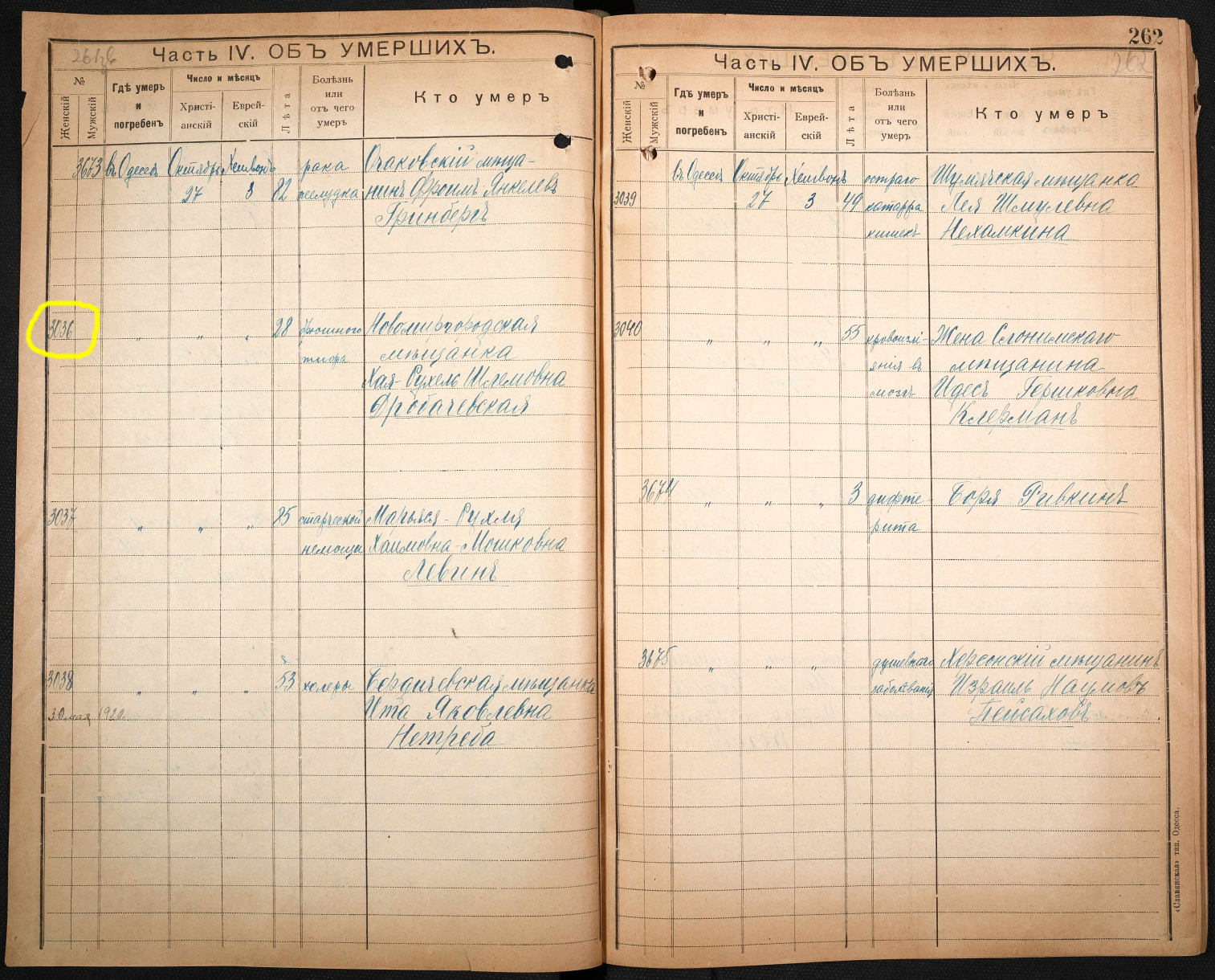
Here is the report of Khaya-Rokhl's death, October 27,
1919...
She succumbed to Typhoid Fever.
click above
More information and a Family Tree provided by Ilya Grigoriev
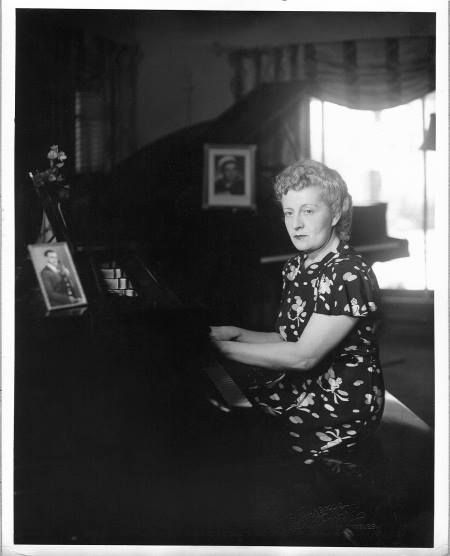
Maria Drobatschewska Borisoff - My Grandmother, was
a child prodigy and after her arrival in Los Angeles,
"Madame Borisoff"
taught many LA area pianists.
Click the picture above to hear a little of Grandma Manya's playing...
Stephen recorded grandma's playing with his Grundig tape recorder which he
hid behind the living room curtain. Sorry, the sound quality is extremely poor.
Maria Dobatschewskai plays
The
Chopin Polonaise in A Major and a part of the
Polonaise in A Flat.
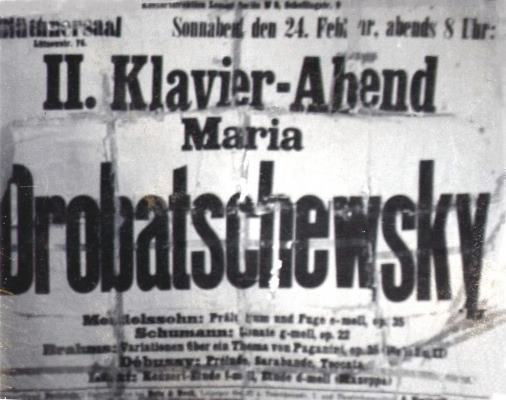
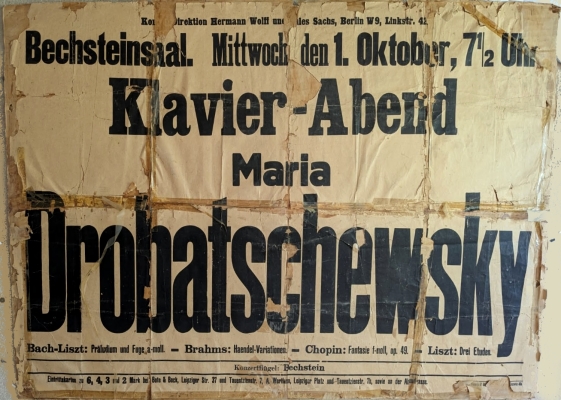
Some of many banners that were found on German concert hall marquees!
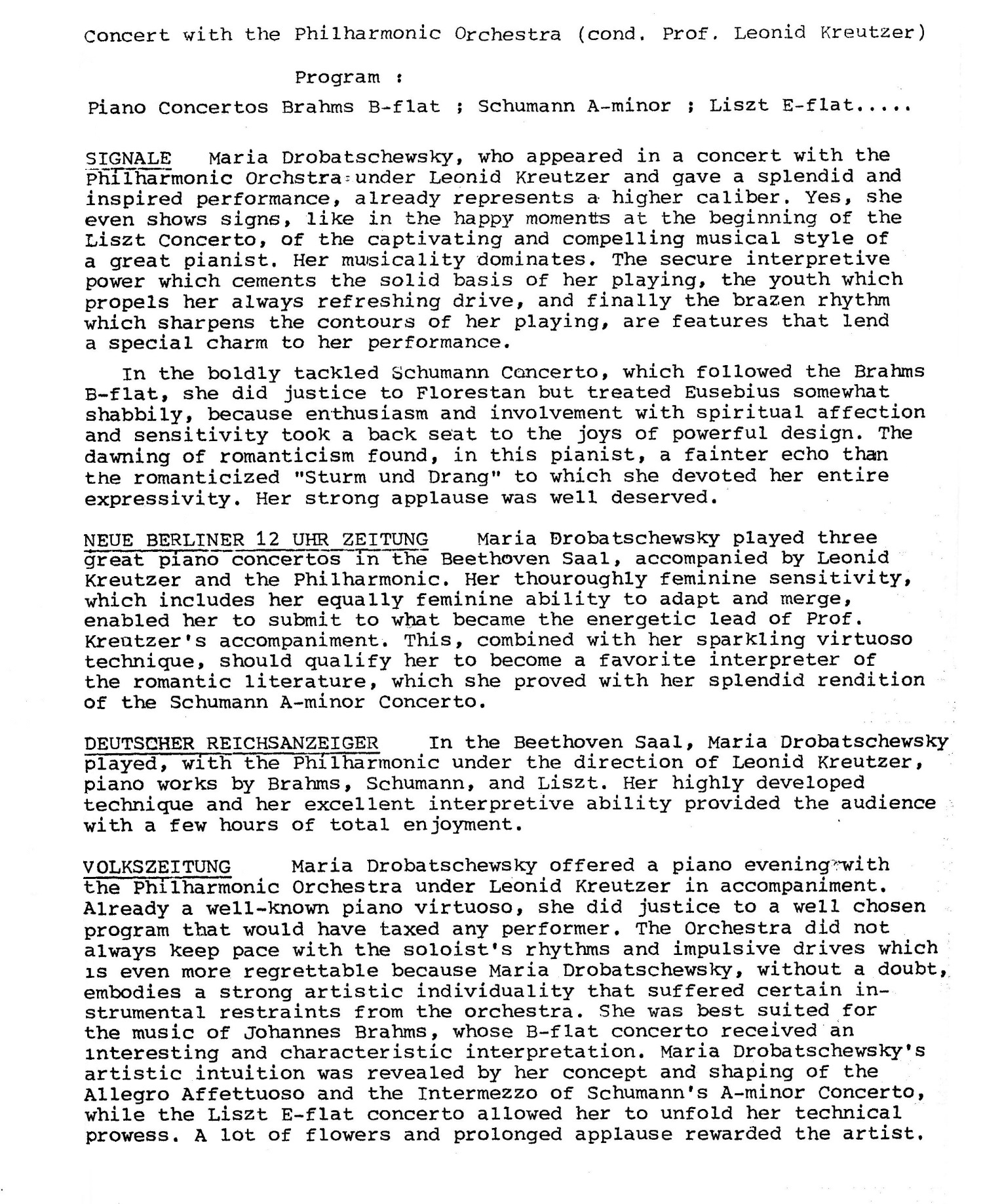
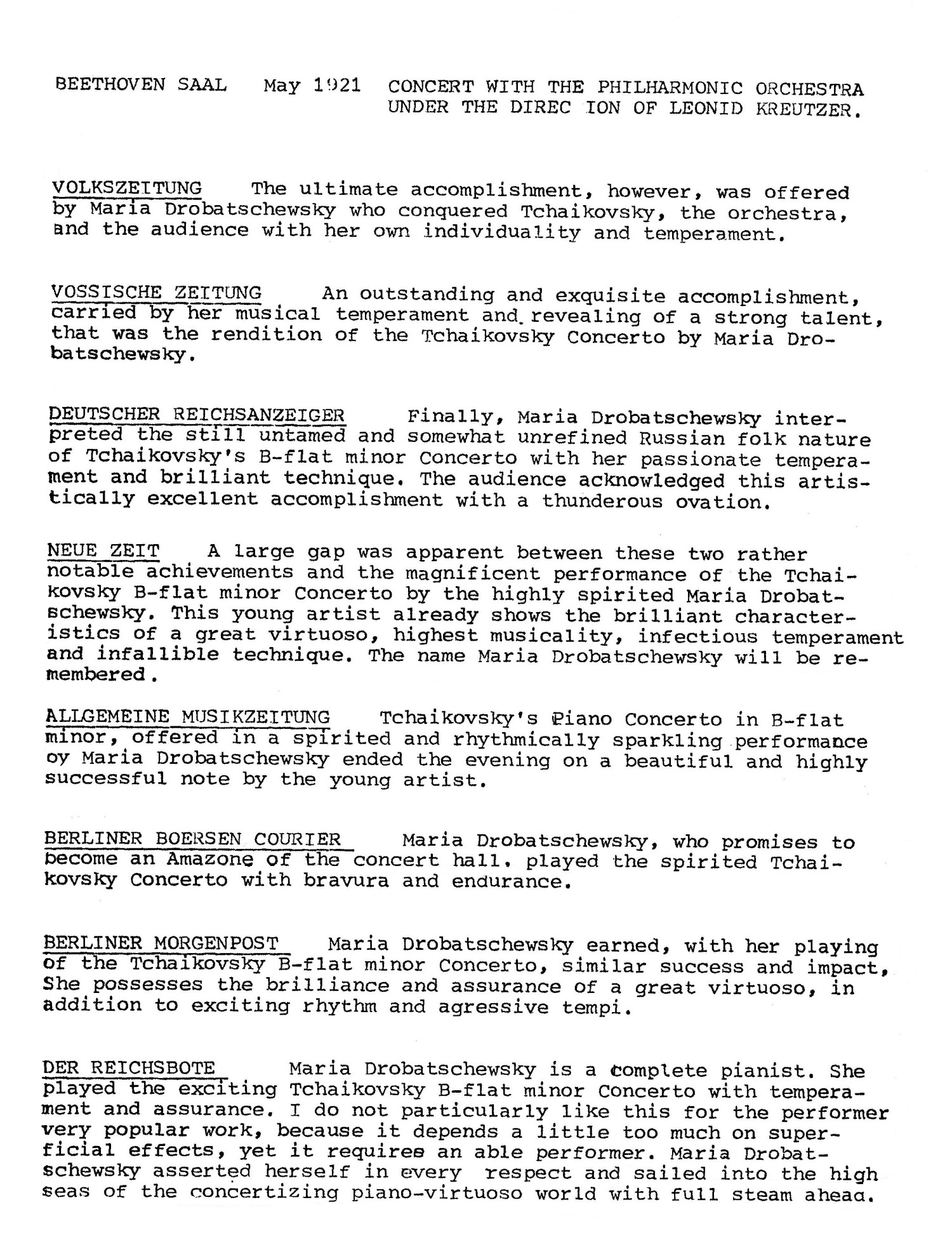
Read reviews from her concertizing years in Berlin, Germany
(click on thumbnails to enlarge)...
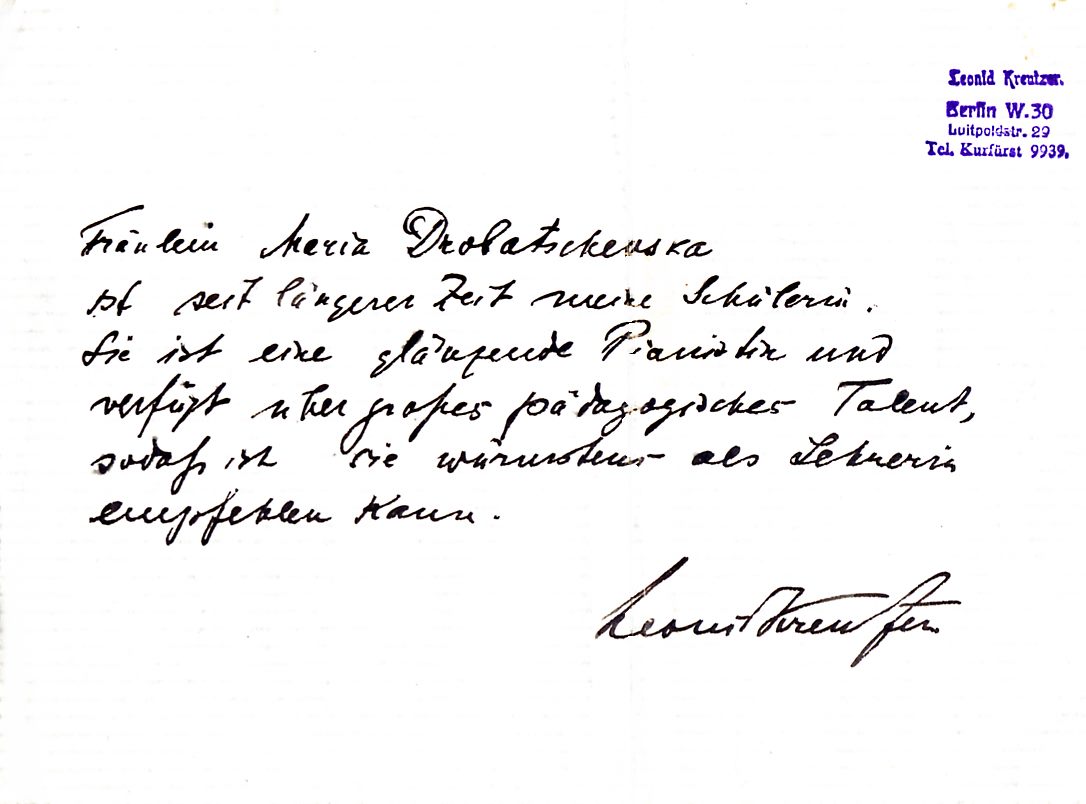
Translation of the note above is provided by Suzanne Wilce...
Miss Maria Drobatschewska is a long time student of mine. She is a brilliant pianist and performer. Moreover, she is just the most naturally talented student I have ever had the pleasure to teach.
Leonid Kreitzer
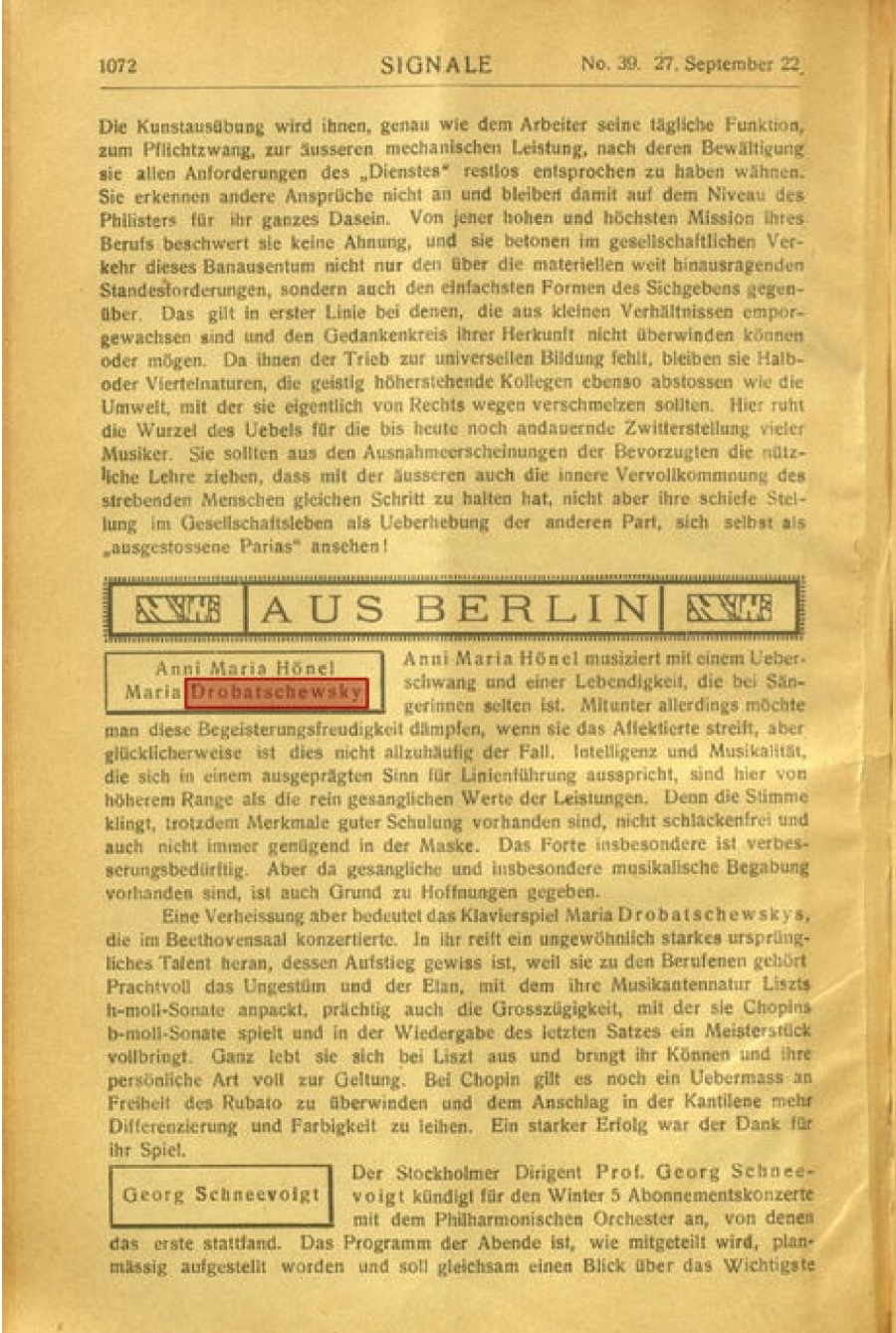
27, September 1919 Volume 77 No. 41
AnniMaria Hönel performs with an exuberance and liveliness rare among singers. Sometimes, however, one might want to dampen this enthusiasm when it borders on affectation, but fortunately, this is not often the case. Intelligence and musicality, expressed in a pronounced sense of line, are of higher rank here than the purely vocal qualities of the performance. For the voice, despite the characteristics of good training, does not sound free of slag and is not always sufficiently in the mask. The forte, in particular, needs improvement. But since vocal and especially musical talent are present, there is also reason for hope. But the piano playing of Maria Drobatschewsky, who performed in the Beethoven Hall, is a promise. An unusually strong, original talent is maturing within her, whose rise is certain because she is one of those called to it. The impetuosity and verve with which her musical nature tackles Liszt's B minor Sonata are magnificent, as is the generosity with which she plays Chopin's B minor Sonata, creating a masterpiece in her rendering of the last movement. She fully expresses herself with Liszt and brings her skill and personal style to full effect. With Chopin, an excess of rubato freedom still needs to be overcome and the touch in the cantilena needs to be given more differentiation and color. The thanks for her playing were a great success.
Bravo!
 |
 |
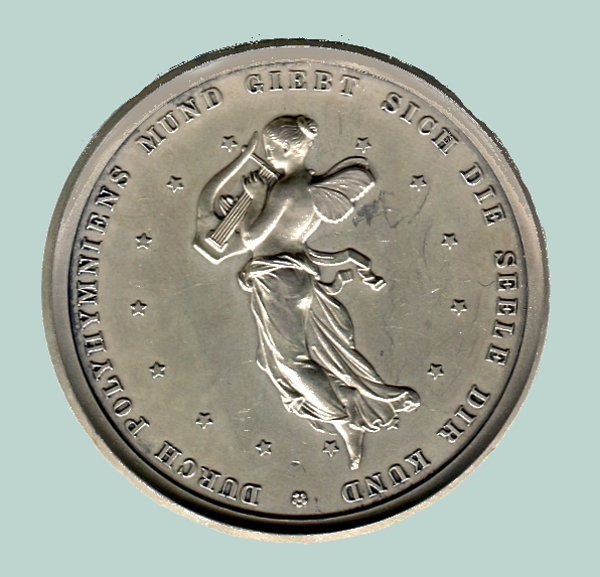 |
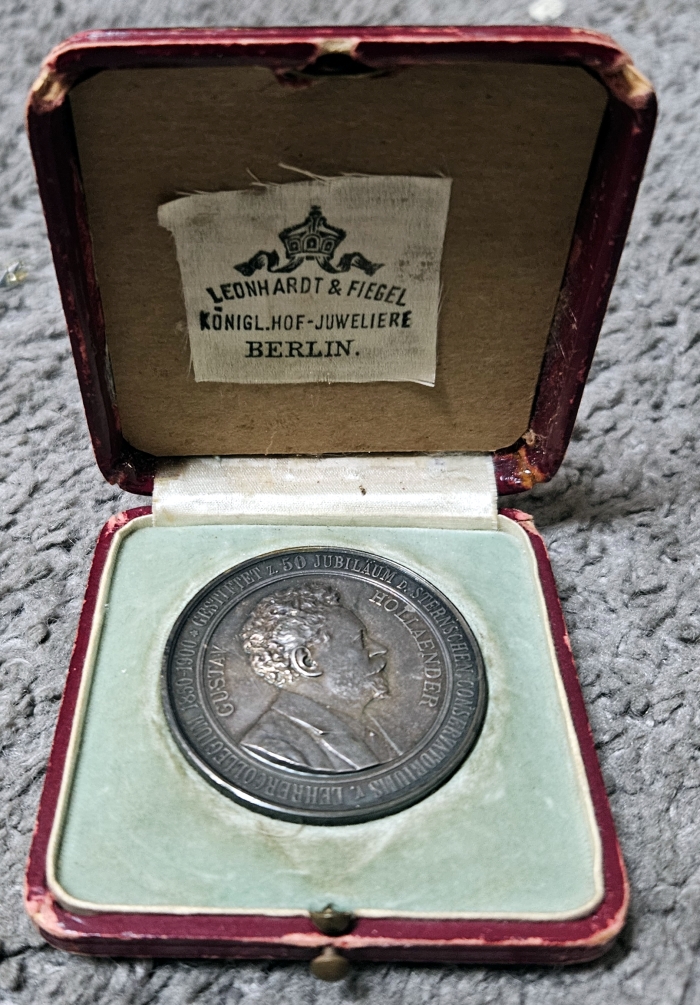
Young Maria Drobatschewska won this
medal in a piano competition. She played behind a curtain where the judges
could not see her. Some of her competitors were here seniors both in age and
experience... The medal was awarded by the
Stern’sche Koncervatorium of
Music, Berlin where she received her training.
This documentation was provided by Ilya Gregoriev, a cousin in the Fidelman
(Fiedemann) family line...
Allgemeine Musikzeitung (March 14, 1913).
Drobatschewsky, Heinrich
Studienbeginn: 01.09.1910
Violine (Fiedemann)
Drobatschewsky, Maria
Studienbeginn: 01.09.1910
Klavier (Bertram)
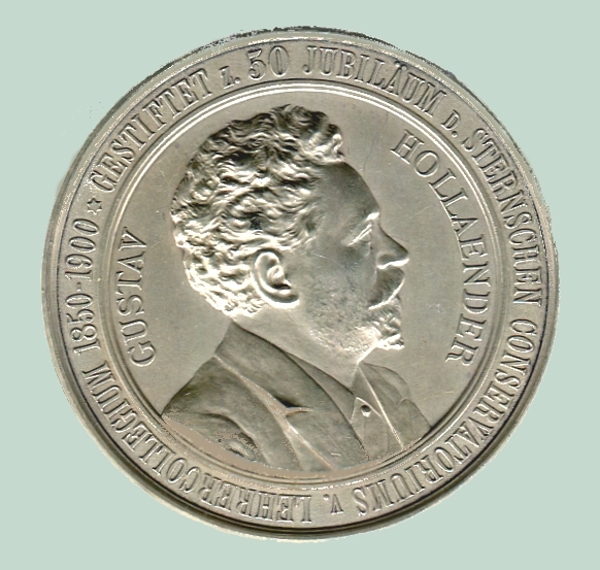
This is a jubilee medal dedicated to the 50th anniversary of the Stern’sche Koncervatorium in 1900. Maria Drobachewska was 4 years old that year. I have many documents from the Stern’sche Koncervatorium in my archive from those years (they were kindly sent to me from the Berlin University of the Arts), Maria Drobachewskaya and her brother Genich entered the Koncervatorium in 1910.
In 1910, Maria was 14 years old. Perhaps she was awarded this medal at some event in the early 1910s.
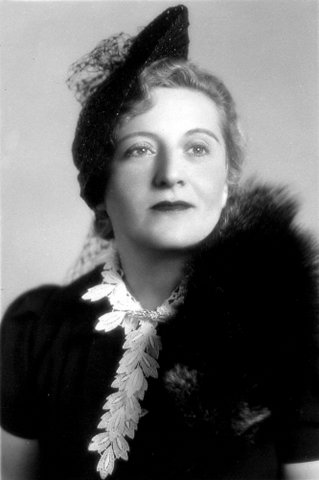
Madame Drobatschewska
In her own words... a short description of Maria (Drobatschewska) Borisoff's musical training and concertizing in pre-war Berlin... excerpted from her later statement to the German government when she applied for reparations...
I, Maria Fuchs Borisoff, born
Drobatschewska, was born an *April 4, 1899, in Odessa, Russia. I attended
the imperial school of music and relocated to Berlin in October, 1910.
I enjoyed private instruction in piano with Georg Bertram, Berlin W. 30, Haberlandstrasse 3. In September 1911, I continued my study at the
Stern’sche Konservatorium der Musik
(1850-1936) where, on July 1, 1914 I received
the Gustav Dutchman medal for my musical achievement. Then I became
the master pupil of Leonid Kreutzer, professor at the national University in
Berlin. I obtained official certification to concertize and teach
piano. I performed in Berlin to sold out houses and received rav
reviews. I married Mischa Fuchs on April 5, 1923. With Hitler's
seizure of power in January 1933 and when Jews were forbidden to concertize,
I had to terminate my musical career. We emigrated to the United
States on 25th of May 1934.
*Important note: Maria Drobratschewska was in fact born an April 6,
1896, and passed away one month short of her 93rd birthday. This
confirmed by Jewish records...
**My grandmother said very little about her upbringing. Nothing about her early life in Odessa. I knew that her brother was killed in Auschwitz and she kept a picture of him on the Bechstein Piano. I also learned that she had a boyfriend who had died of Tuberculosis. After so many difficult times, it was no wonder that she tried so hard to shield us from the events of the real world around. She was rarely emotional, very stoic, and the only taken back when I told her that Marilyn Monroe had died. She reacted, saying, "I have goose bumps!"
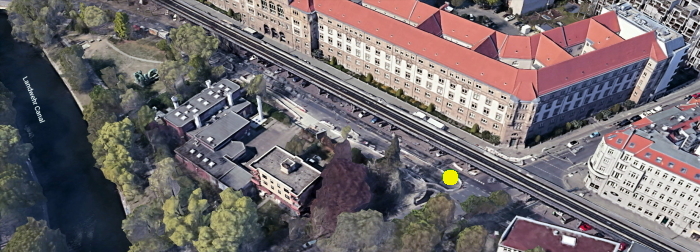
Here is the Modern day location of #1 Gitschiner Strasse, Berlin. This is the street where my grandparents and father resided while in Berlin. The yellow dot indicates where their condominium once stood. The area was bombed out during the war and the street's location was changed when the area was rebuilt. Dad used to ice skate on the canal located on the left.
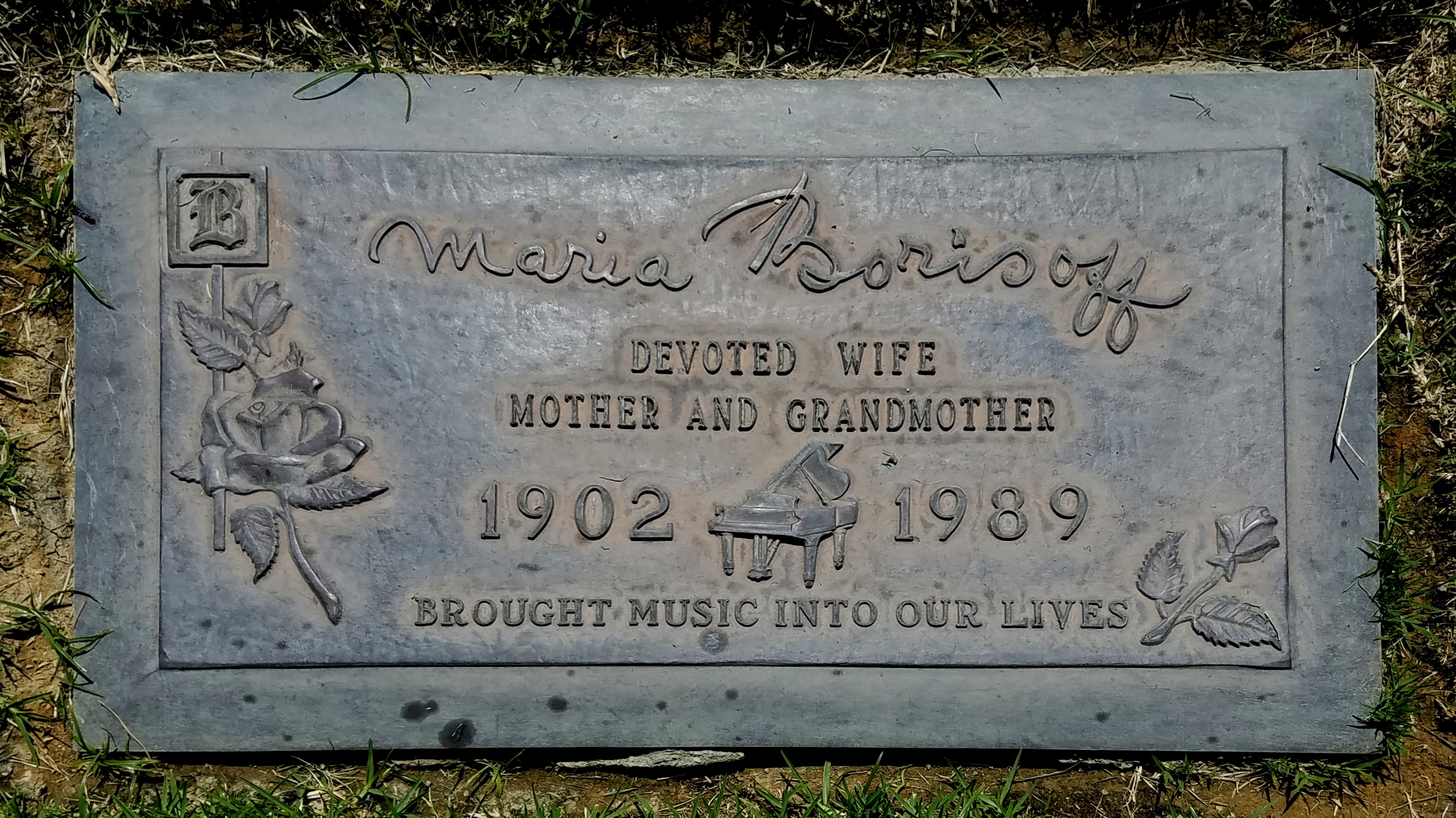
Maria Drobatschewska Borisoff's
Eulogy, February
27, 1989
written by her daughter-in-law, Edith Borisoff.
Maria Borisoff was born in Odessa
Russia 86 years ago, the youngest of 5 children. The entire family was
totally immersed in music and at the ripe old age of 8, Manya, as she was
affectionately called, was whisked away to Berlin by Uncle Fiedemann, who
maintained that she was a budding child prodigy and that this talent needed
to be cultivated in an atmosphere more appropriate than Czarist Russia.
The Berlin of 1910 was teeming with culture and music. Into this milieu came this child, ready to study and work toward the goal of concert pianist. To make ends meet, she donned high heels to look much older, so that she could take on students who were just a few years younger than she was. It wasn't too long before she took to the concert stage and received glowing reviews.
In 1923 she married Mischa Borisoff and two years later gave birth to their son, Boris, the light of their lives.
With the establishment of the Hitler regime in 1933, an early incident awakened them to the need for leaving the country. First plans were to emigrate to Palestine but, on the urging of Uncle Sascha, successfully established in Los Angeles, they decided to come to America, arriving in 1934.
For the second time in her life she was uprooted and thrust into a different culture. Here she was, no language but that of music, trying to find herself and help provide for the family in the midst of the U.S. side of the great depression. She did it all, raised a wonderful, bright child, gave music lessons and recitals, and established herself in the musical world of L. A. She loved the excitement, the rush and the challenges of a busy working life.
Unfortunately, 'Bob' was not imbued with his parents' great interest in music, but instead preferred to tinker with motors and old watches. After several failed attempts at the piano and the violin, Manya gave up on a musical career for Bob.
With the coming of World War II and the holocaust, she tried valiantly to bring her brother and his family to the U. S. with partial success. Her beloved brother, Heinrich, and all of her remaining family in Russia were lost.
1948 saw Bob's marriage to Edith and the subsequent birth of the twins, Stephen and Paul. All her energies went into the care and nurturing of her beloved twins. All this time she harbored the not-so-secret dream that they should take up the musical mantle of her interrupted career. This task took on the manner of a crusade when she purchased their first piano on the occasion of their fifth birthday.
Before long she had two more "victims" in the persons of David and Susan. There was the fun of staying at Grandma Manya's house for the weekend and getting all of her personal attention including a music lesson. Trips to Desert Hot Springs were also part of life with Grandma with all of the hustle and bustle of packing up and getting on the road before the traffic began. But behind all of this was her first and foremost goal: that of the children's musical education. One would have to say that she succeeded. Every one of the children is in some measure connected to music and finds it an integral part of his life.
Mischa passed away in 1964 and with him went a great deal of the meaning of her life. The children grew up and, as children will, they grew away. They all married and had children of their own and shared their joy with their Grandma Manya.
Age and infirmity took its toll and Manya was no longer able to fend for herself, so she resorted to living in a retirement hotel. When that was no longer feasible, she moved to Petit House and was cared for tirelessly by their caring staff. Her latest accident made hospitalization necessary and with that - her passing on February 27. Those powerfully talented fingers, once acclaimed throughout Europe, are stilled, but ...the melody lingers on...
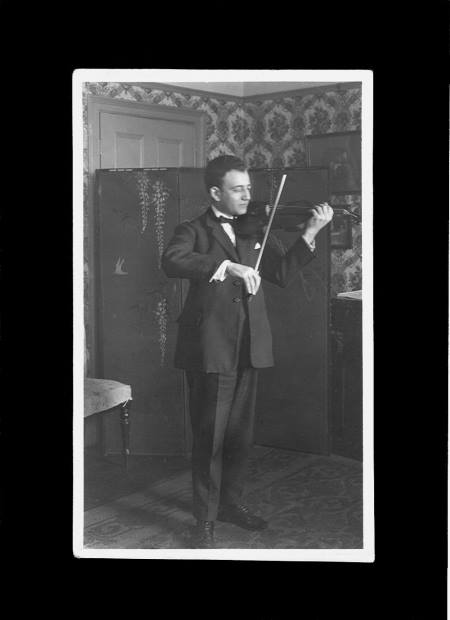
Heinrich Drobatschewsky - My Great Uncle - Maria's Brother
A Brilliant Violinist whose life was cut short in a German Concentration Camp.
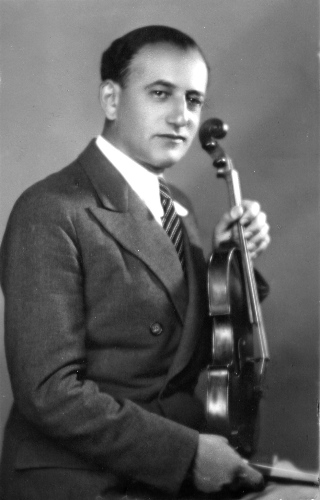
Uncle Heinrich was a noted European violinist
and concert master for various large German and Dutch Orchestras. He was trained
by the eminent teacher, Carl Fleisch. Members of his family made
valiant attempts to bring him to safety, but these efforts were in vain.
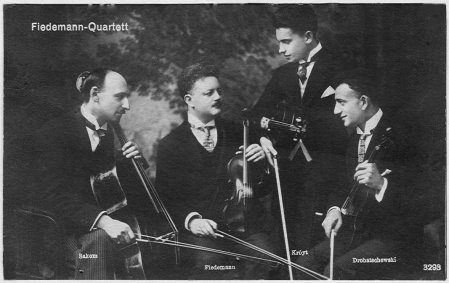
Uncle Heinrich (far right) Member of the Fiedemann Quartet
For many years, we were unsure whether "Uncle"
Fiedemann was a relation or if "Uncle" was just a title of respect given to
a close friend of the family. Heinrich Drobatschewsky played in his quartet. I understand
that the quartet was quite well known and in recent years I have been
contacted by persons very interested in their artistry.
I was introduced to a family member currently living in the Netherlands and
have met members of the Fidelman (Fiedemann) family line. This is
helping to document maefamily!
Alexander Fiedemann was the brother of Sonya
Fiedemann. Sonya Fiedemann Drobatschewska was wife to Solomon Drobatschewsky... the Grandmother of Genich (Heinrich), Khaya-Rokhl, Reisa
& Fenya (fraternal twins) and Maryam (Maria). Indeed, he was their Uncle. Heinrich and
Maria were sent to Berlin under the care of Uncle Fiedemann. Their
musical talent and future study were their ticket out of the Ukraine, away
from the Tzar Nicholas, the pogroms and all that threatened their Shtetl.
Things went well till the rise of the Nazi regime.
Upon the death of Alexander Fiedemann, this memorial
was published...
Alexander Fiedemann died in Prague, in the sanatorium where he was
recovering from the surgery...
On the 28th of January, 1940, the violin virtuoso, chamber musician and
pedagogue Prof. Alexander Fiedemann, who lived here for several years in
complete seclusion, passed away in Prague. He was a favorite of the great
violinist Adolf Brodsky and has himself trained a significant number of fine
artists, including some of world renown such as Mischa Elman, Toscha Seidl,
and others. The Fiedelamm Quartet, founded by him in 1916, was one of the
best in the world at the time. With Alexander Fiedemann an important
musician and noble, noble person has passed away.
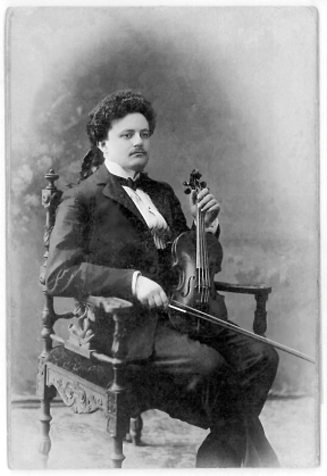
Uncle Alexander Fiedemann
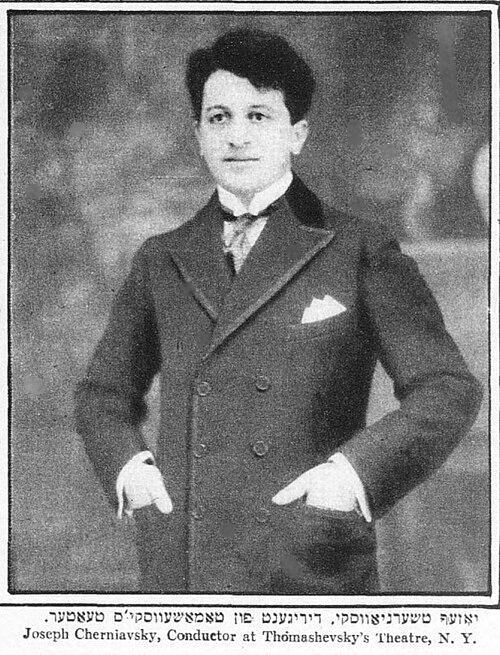
Sonya Fiedemann's nephew, Joseph Cherniavsky was a noted musician...(c.1890-1959) was a Jewish American cellist,
theatre and film composer, orchestra director, and recording artist. He
wrote for the Yiddish theatre, made some of the earliest novelty recordings
mixing American popular music,
Jazz and klezmer
in the mid-1920s, was also musical director at
Universal Studios in 1928-1929, and had a long career in radio and
musical theatre.
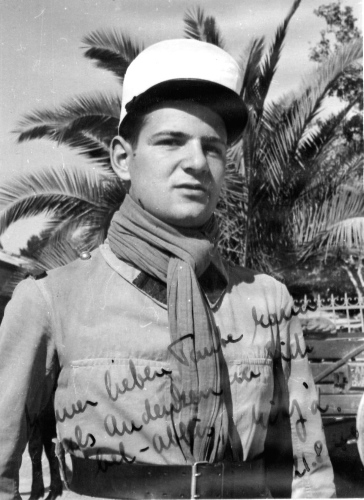
Dimitri Drobatschewsky in "Beau Geste,
1966"
Real Legionnaires were recruited to add
authenticity... The film however was not
an Academy Award contender!
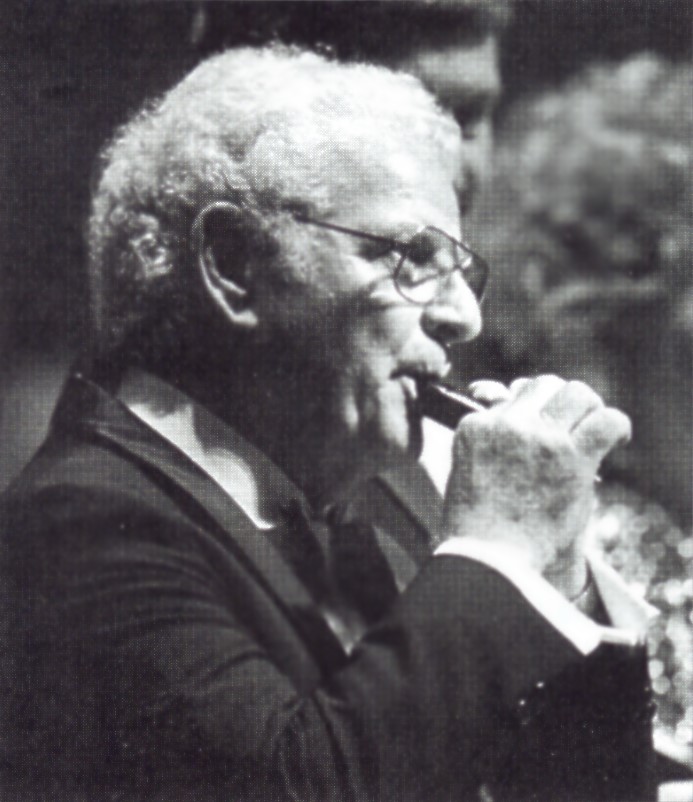
Playing the toy trumpet part of
Leopold
Mozart's Toy Symphony
During World War II, Heinrich's son, Dimitri, joined the Vichy Foreign Legion. He served until the spring of 1942, then he deserted and rejoined De Gaulle's Free French Forces in Libya. That army also had a brigade of Foreign Legionnaires, so he remained a legionnaire. With the Free French Forces, he fought the Nazis not only in France, but also in Egypt, Libya, Tunisia, Italy and finally, France and Germany. After immigrating to the United States, he became a music critic for a Arizona Republic. Once, when asked what credentials supported his being a music critic, he responded, "In order to be a music critic, your last name must be very long!" Despite the hardship and loss of the war years, Dimitri is blessed with a wonderful sense of humor and passion for life and the arts.
Update: Dimitri Drobatschewsky (May 7, 1922 - December 15, 2012)
Mitja passed away peacefully in his daughter's home in Arizona, He was 90 years old. He is survived by his son, Serge and daughter Stephanie.
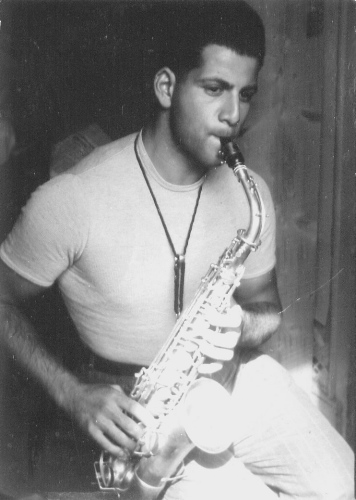
Dimitri's Brother, Vladimir Drobatschewsky.
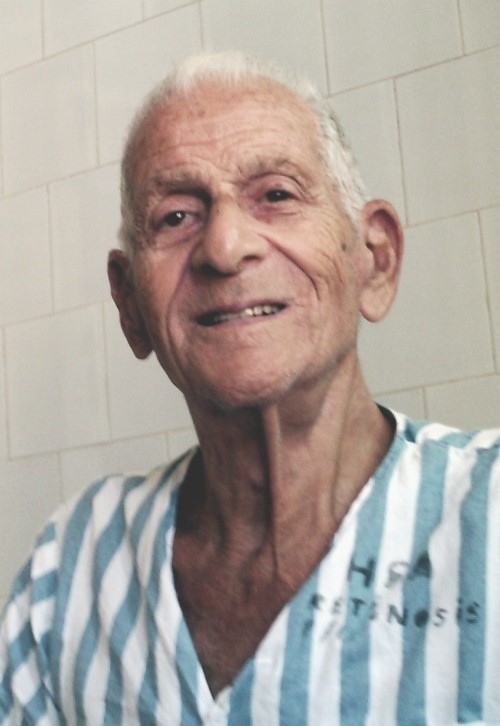
Update September 14, 2010 from Dimitri Drobatschewsky:
Hello, Bob and Paul
A bit of sad news: today, my brother Wowo died peacefully in his bed, after a very long illness and three strokes. Given his condition and medical history, I consider his death mostly a deliverance; he did not enjoy life during the last year or so and he was unable to do anything other than be dependent on his 24/7 caretaker. But we all have good memories of and about him, and he was an excellent musician. He will be buried Wednesday, in Havana. Hope all is well with you. Vladimir was 90 years old.
All the best, Mitja
The true story as uncovered by researcher, cousin Ilya Grigoriev... Click Here
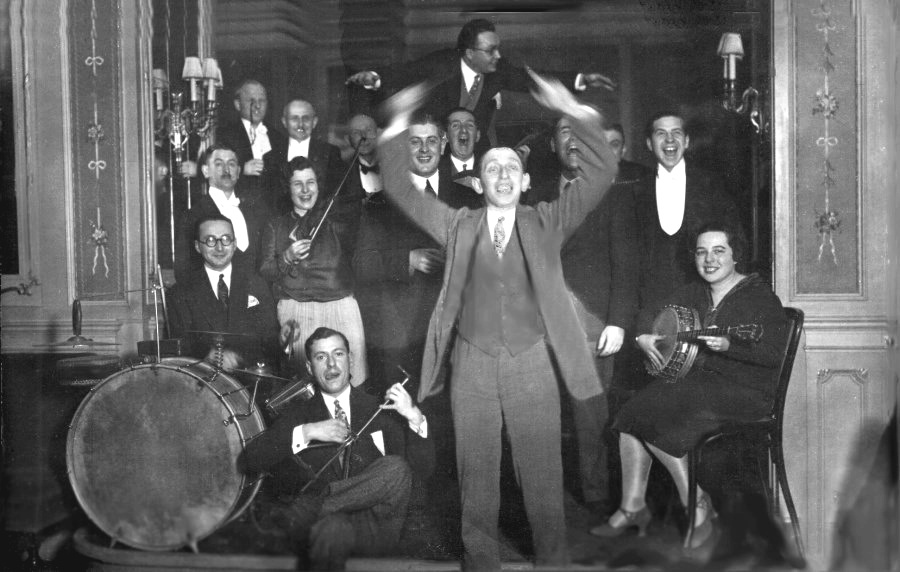
Grandpa Mischa (top center) - Conducting the back row?
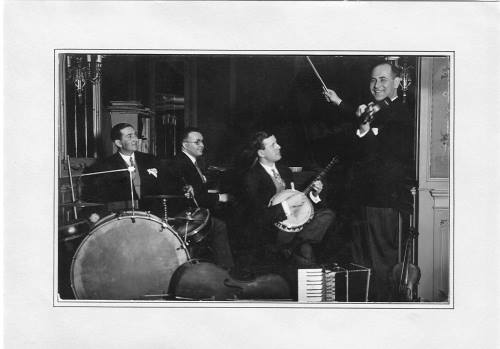
Mischa Borisoff (2nd from the left) - My Grandfather
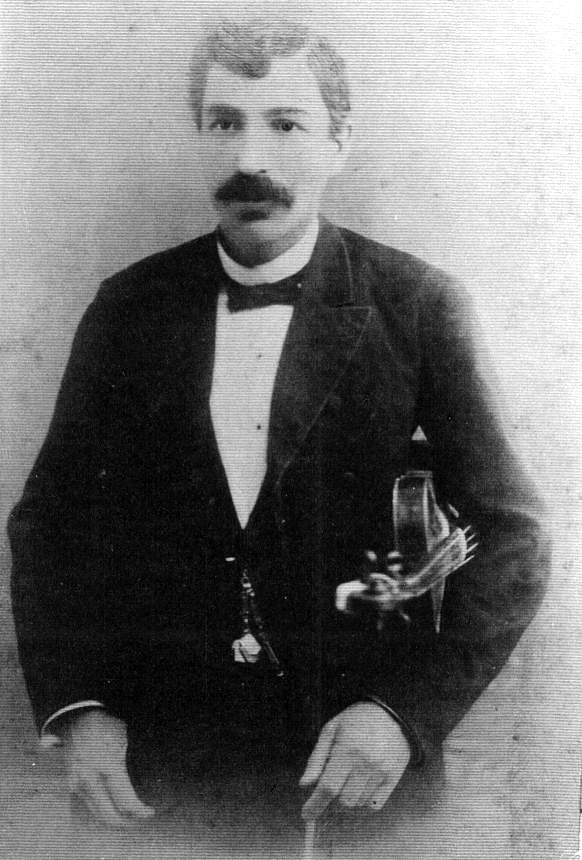
Boris Fuchs Borisoff - Mischa and Sascha Borisoff's Father
He was an accomplished violinist and also owned a hosiery factory. He apparently was well off until Stalin's Bolsheviks jailed and then killed him. Maria Borisoff reported that she had heard that the Bolshevik fanatics also blew up the factory despite a great scarcity of clothing needed for the Russian winter.
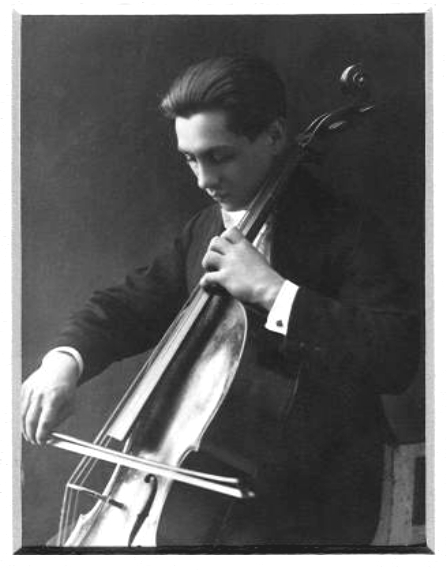
Alexander Borisoff Nickname: Sascha
AKA Alex Alexander
Alexander Borisoff was born in Odessa, Russia. He attended the Russian
Koncervatorium of Music where he majored in Composition and Cello. He
graduated with a Doctorate in Music and performed as a concert cellist in a
series of highly successful appearances throughout Europe before coming to
America. While touring the United States, Alexander was invited by Dr. Otto
Klemperer to join the Los Angeles Philharmonic as their first cellist.
During his tenure with the Philharmonic, Alexander introduced his Cello
Concerto and his Poeme Ancient for Cello, Narrator, Chorus & Orchestra.
Alexander was commissioned by NBC to compose a tone poem for Symphony
Orchestra based upon the theme America which was played by the Los Angeles
Philharmonic over a coast-to-coast broadcast and subsequently performed by
major symphony orchestras throughout the United States. In 1971, Alexander's
String Quartet was recorded by the American Chamber Virtuosi and in 1975 his
Impressions of Hawaii was commissioned and performed by the Honolulu
Symphony Orchestra. He wrote scores for many Hollywood motion pictures and
television programs and has also made musical arrangements for well-known
vocalists and recording groups. He also wrote books on musical composition.
Alexander sadly passed away in the early 1980s.
Click here to hear Bob Borisoff talk about the family experience in Nazi
Berlin in a conversation with Steven Spielberg's Shoah representative...
Sascha Borisoff worked with lawyer, Harry Rabwin to arrange an exit from
Berlin after Grandpa Mischa was involved in a fight with brown shirt nazi
youths.
Click here to read an LA Times article about Uncle Sascha's house on Cheswick Lane where he hosted many home concerts featuring the most famous and talented artists. Also, an informative Family Timeline.

And the talent continues...
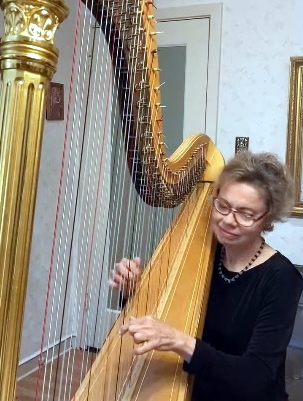
Click Janice's picture for a little harp serenade.
Janice Ortega - My Cousin (Alexander Borisoff's Grand daughter)
Janice was influenced by great harp
teachers beginning with Wenonah Govea, California State University East Bay,
where Janice graduated Magna Cum Laude, Bachelor of Arts in Music. Janice
studied harp performance over several summers at the Aspen Music School with
Nancy Allen of The Julliard School and Principal Harpist of the New York
Philharmonic Orchestra.
Janice completed post-graduate studies in harp performance at the Royal
Koncervatorium of the Netherlands as part of the Artist Diploma Program.
Janice studied with Phia Berghout, Principal Harpist with the Royal
Concertgebouw Orchestra, in Amsterdam. The Independent newspaper of the UK,
Saturday 27 March 1993 01:02, described Phia Berghout as “arguably the most
influential harpist this century.”
Janice earned the Master of Music degree in Harp Performance with a Pedagogy
Minor from Indiana University under the direction of Susann McDonald. Her
curriculum included improvisational jazz harp, pedagogy, advanced theory and
ear training, open score reading, keyboard facility, and figured bass
reading. The American Harp Journal, Winter 2017, wrote: "Susann McDonald is
one of the great harpists and harp teachers in the world. She has been a
teacher and a role model to an amazing number of the most prominent harpists
of our time…”
Janice performed with many European orchestras, beginning with the Royal
Concertgebouw Orchestra, Amsterdam, under the direction of Kiril Kondrashin.
Her later performances included symphony orchestras in Belgium, the
Netherlands, Italy, and Germany, and in the US, with festival orchestras in
Tanglewood and Aspen.
Janice wrote "I was very fortunate to have great harp teachers, and I wish
to continue their legacy." She continues their legacy through private
teaching, four academic appointments, and recently through a series of
videos on advanced performance techniques for the harp sponsored by the
American Harp Society Bay Area Chapter.
Janice’s contributions to the American Harp Society (AHS) span several
decades. During her tenure as co-president of the AHS Bay Area Chapter, the
Chapter sponsored the annual AHS National Harp Conference in San Francisco,
a National Harp Competition, and a Northern California Harp Competition.
Janice also addressed the AHS National Harp Conference as a guest speaker
and concert artist. Linda Rollo, Chairman of the Board, American Harp
Society, reviewed Janice’s concert performance: “This was a beautiful
presentation, well-played, polished and professional. The Shapiro is a
wonderful piece which you played brilliantly, without a hitch. Your speaking
and general rapport with the audience was excellent and I loved the Mozart,
as did the entire audience.” Janice served as President of the AHS Hayward
Chapter and is alumnus advisor for the California State University Chapter
of Mu Phi Epsilon. Visit Janice's Website at
https://harpbayarea.com
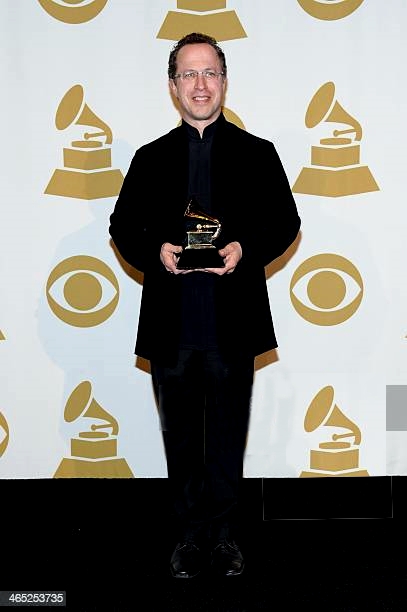
David Alan Miller Conductor - My Cousin
David Alan Miller has established a
reputation as one of the leading American conductors of his generation.
Frequently in demand as a guest conductor, he has worked with most of
America’s major orchestras, developing especially close relationships with
the Minnesota Orchestra and the Chicago Symphony. He has also conducted the
orchestras of Philadelphia, New York, Los Angeles, Detroit, Pittsburgh, San
Francisco, Baltimore, Houston, Milwaukee and Indianapolis, as well as the
New World Symphony and the New York City Ballet.
As Music Director of the Albany Symphony Orchestra, a position he has held
since 1992, Mr. Miller has proven himself a creative and compelling
orchestra builder. Through exploration of unusual repertoire, educational
programming, community outreach and recording initiatives, he has reaffirmed
the Albany Symphony’s reputation as the nation’s leading champion of
American symphonic music and one of its most innovative orchestras. Recent
honors include Columbia University’s 2003 Ditson Conductor’s Award, the
oldest award honoring conductors for their commitment to American music.
Additionally, Mr. Miller has received the 2001 ASCAP Morton Gould Award for
Innovative Programming and, in 1999, ASCAP’s first-ever Leonard Bernstein
Award for Outstanding Educational Programming.
In September, 2006, Mr. Miller opened the Chicago Symphony subscription
season and the Chicago World Music Festival with four highly acclaimed
concerts. During the 2006-7 season, he returns to the Minnesota Orchestra
for his eighth season as conductor, creator and host of its "Casual
Classics" series. Recent highlights included appearances with the Baltimore,
Houston and Milwaukee Symphonies, the Minnesota and Louisville Orchestras,
the Grand Teton Music Festival and his third visit to the Estoril Festival,
Portugal's leading arts festival. He recently traveled to Australia to lead
performances of John Adams oratorio, “El Niño,” at the Sydney Opera House.
Internationally, Mr. Miller made his debut with the RAI Orchestra in Turin,
Italy, in the 1999-2000 season. He has also conducted major European
orchestras in Berlin, Barcelona, Prague, Dresden, Hanover, Halle and Mainz.
He has appeared with the Adelaide Symphony, Hong Kong Philharmonic, and
Singapore Symphony; led the Australian Youth Orchestra on its European tour;
and conducted the Asian Youth Orchestra on a major tour of the Far East that
included concerts in Japan, Korea, Hong Kong and Singapore. In Canada, he
has conducted the National Arts Centre Orchestra in Ottawa and the Edmonton
Symphony.
Mr. Miller is highly regarded as a champion and interpreter of American
music, new and old. His extensive discography includes recordings of the
works of Todd Levin with the London Symphony Orchestra for Deutsche
Grammophon, as well as music by Michael Daugherty, Kamran Ince, and Michael
Torke for London/Decca. His recordings with the Albany Symphony include
discs of music by John Harbison, Roy Harris, Morton Gould, Don Gillis,
Vincent Persichetti, George Lloyd and Peter Mennin, all on the Albany
Records label. He also led the Los Angeles Philharmonic in its recording of
Mel Powell’s music, including “Duplicates: Concerto for Two Pianos,” winner
of the 1990 Pulitzer Prize for Music. Mr. Miller's most recent CD release is
the world premiere recording of Michael Torke's opera, Strawberry Fields, on
the Ecstatic Records label. He is currently completing a disc of major works
by Greek-American George Tsontakis with the Albany Symphony for Koch. Mr.
Miller is the founder and Artistic Director of New Paths in Music, a
festival in New York City dedicated to presenting the works of significant
non-American composers who are not yet well-known in the U.S.
Prior to his appointment in Albany, Mr. Miller was Associate Conductor of
the Los Angeles Philharmonic. During his five-year tenure there, he
conducted subscription concerts, special programs at the Hollywood Bowl, and
Symphonies for Youth concerts, and he led the orchestra in premieres of
numerous works. From 1982 to 1988, he was Music Director of the New York
Youth Symphony, earning considerable acclaim for his work with that
ensemble. A native of Los Angeles, David Alan Miller holds a bachelor’s
degree from the University of California, Berkeley, and a master’s degree in
orchestral conducting from The Juilliard School. Mr. Miller lives with his
wife and three children in Slingerlands, New York.
David was born into a musical family. His father, Gerald Miller, served for many years as a Cantor at Temple Judea in the San Fernando Valley. He also taught music classes at Monroe High School.
 |
|
|
|
|
|
Master Paul H. Borisoff |
|
 |
|
|
|
|
|
|
|
|
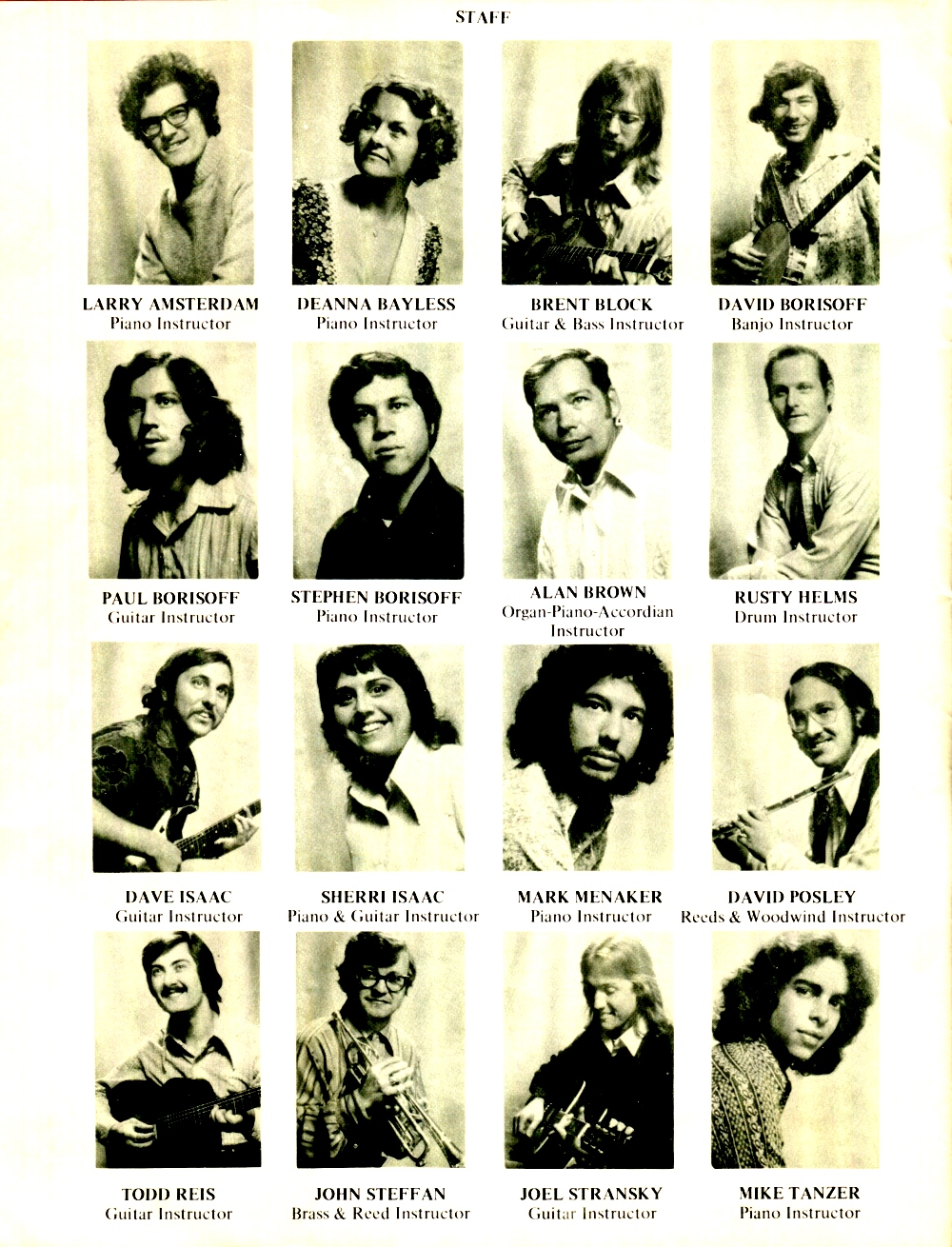
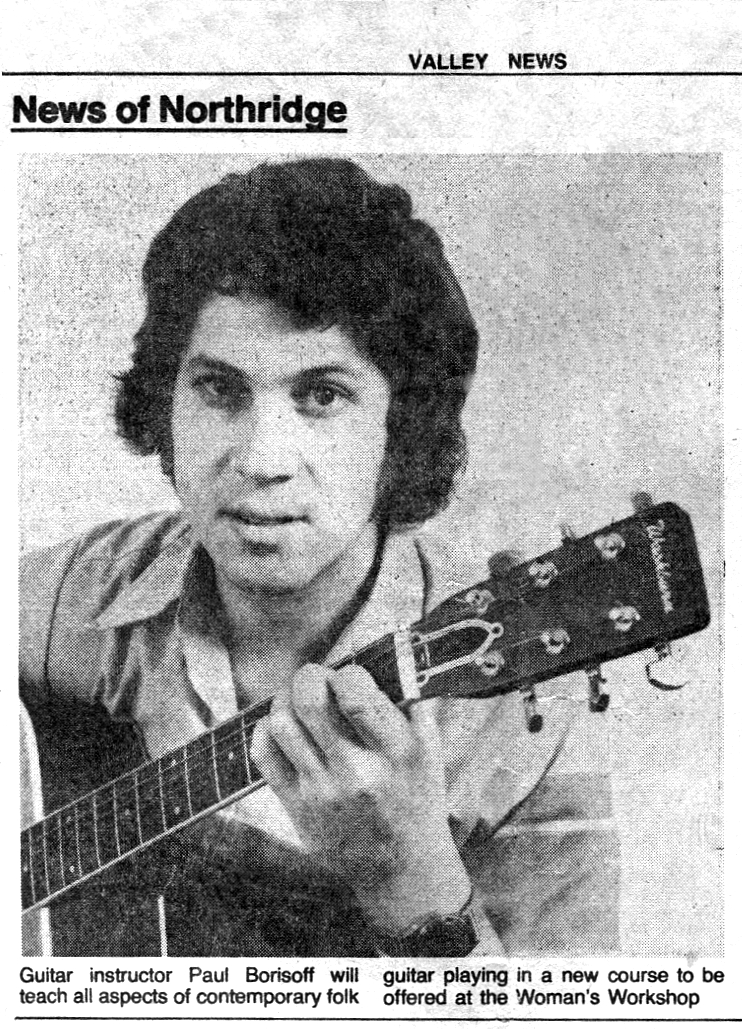
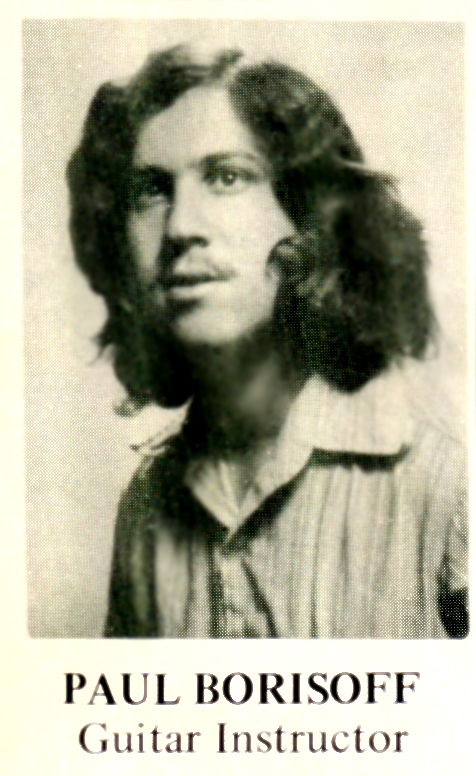
Paul Borisoff began teaching contemporary folk guitar in 1967 for Jerry Finn Music. Lessons were given in the student's home. Later Jerry opened Finn's Music Emporium in Sherman Oaks. It was not long after that all the Borisoff youth were teaching a variety of different instruments for 'Uncle Jerry'. Paul taught at many venues including L.A. Recreation and Parks, The Woman's Workshop, Every Woman's Village, The YMCA, and YWCA. In addition, he taught photography after receiving his bachelors degree in Radio, Television and Film Communications from CSUN. L.A Recreation and Parks, LAUSD Inservice and Pierce College Community Adult hosted his Kung Fu classes; helping teachers and the community deal with the Hillside Strangler scare. He has continued to teach Kung Fu over the past 44 years.
|
|
|
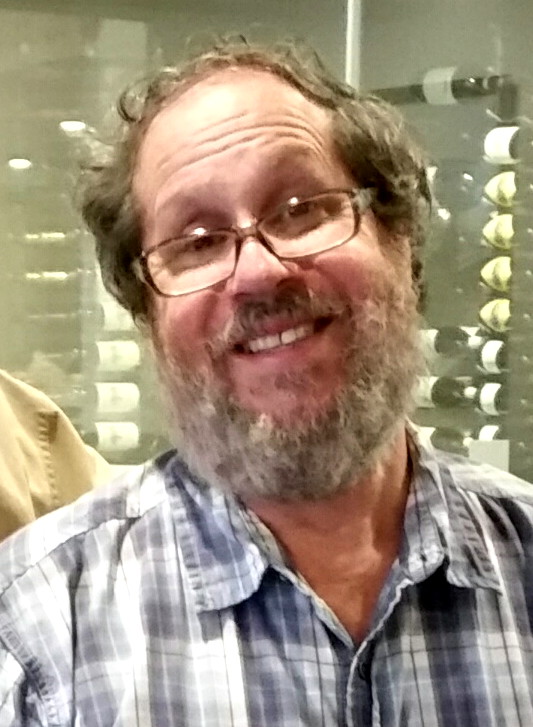
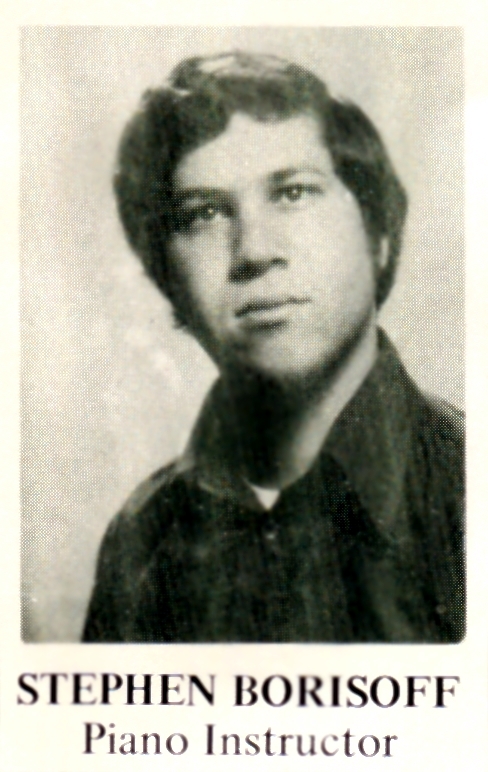
My Brother Stephen |
|
 |
 |
|
Stephen inherited a love of Chopin's compositions from
my grandmother. He practiced them endlessly throughout our childhood.
In fact, every time I picked up my guitar to play, he'd come bounding down
the stairs, hop on the piano bench and perform The Polonaise in the most strident
manner!
Needless to say, my guitar didn't stand a chance against his mighty piano
exploits!
It's a Bittersweet Symphony, This Life
Sonata in C Major...
Nocturne (The Gypsy) in C# Minor
Take me to Stephen's channel on Youtube for a variety of entertaining videos |
|
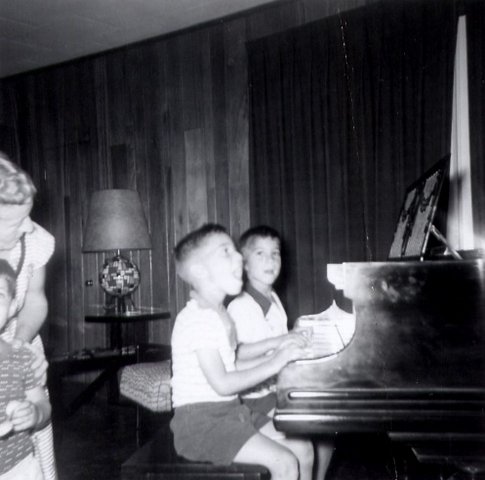
From right to left, Grandma, David (D.J), Paul and Stephen
Note:
Grandma referred to us
as her two victims!
Notice our little brother
David, escaping!
David Joshua Borisoff - My Brother
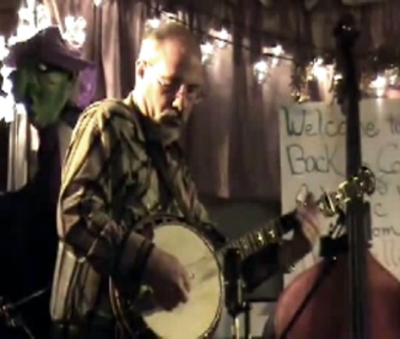
David abandoned the piano at young age and decided one day to take up banjo... What a strange instrument, we all thought. Well, he really became very good at it... and the what the heck, we all loved The Beverly Hillbillies. At one point David sought out and took a lesson from the famous Herb Peterson of the Dillards. The lesson went well and Herb advised David that he was VERY good and there wasn't a lot more that he could teach him. David also has mastered the Steel Guitar. He put both skills to use playing on a bluegrass circuit with the Red Rock Ramblers at venues like Putney Station and Cal's Corral. Accompanying him were song writer, Jim Fowler and Kate Mcdonald, a fine vocalist to whom he soon married. David is the owner of Hipshot Products, producing a fine line unique bass and guitar products and accessories...
An interview
with David Borisoff - WHCU Radio
More
about Hipshot Products, New York.)
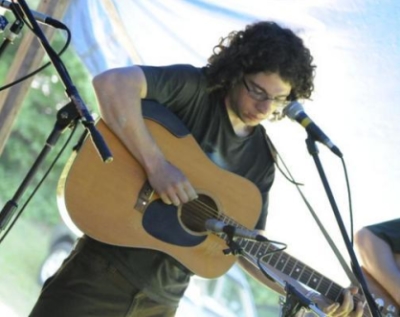
Jason Borisoff (David's son)
(Click here to listen to one
of their tunes)
A Tribute...
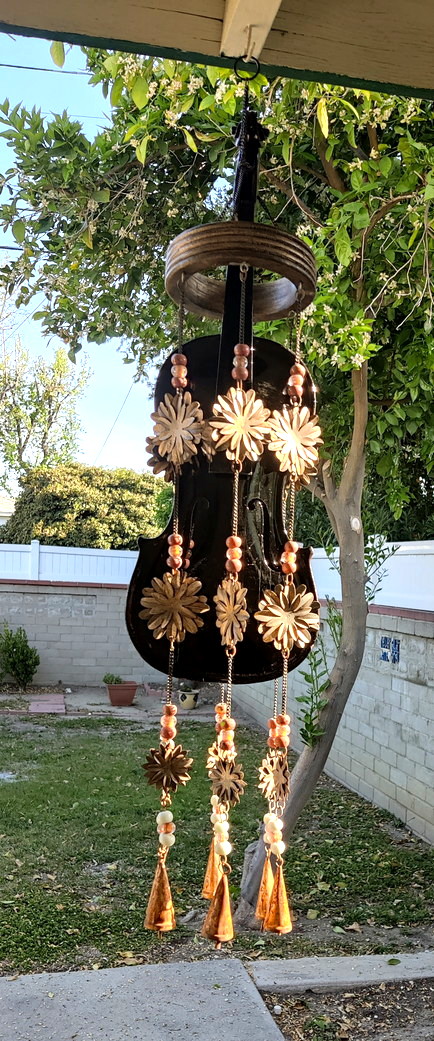
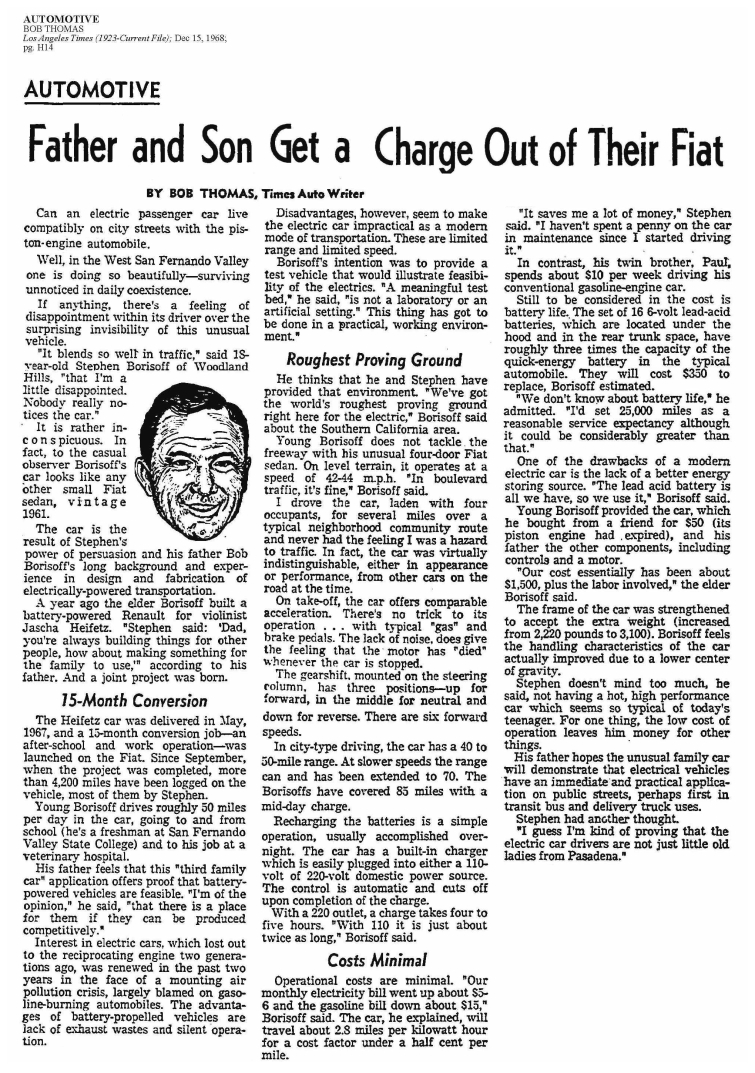
Befallen by the back side of its
proud player... now
enshrined as a wind chime! There is life after wreckage.
"In the jingle, jangle morning, I'll come following you." Bob dylan
This
instrument is in no way related to or crafted by Antonio Stadivari.
Scratch-a-various is a credit to the creative genius of Richard Patrick,
whom
without, this violin would remain nameless and in obscurity.
Sad to report... during the first rain the violin-wind chime
spontaneously
un-glued, never more to sing, ting or bing.
-Maestro-
For more on Maestro's Family...
More
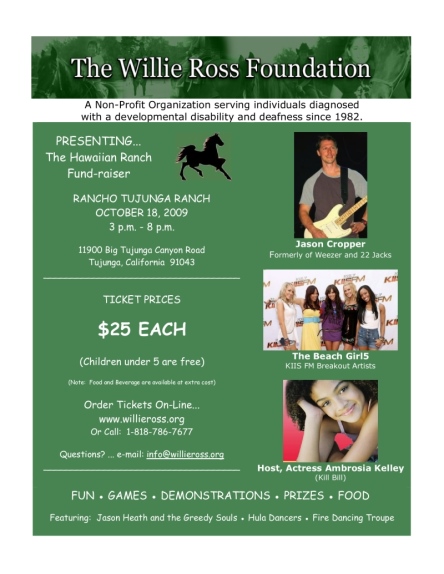
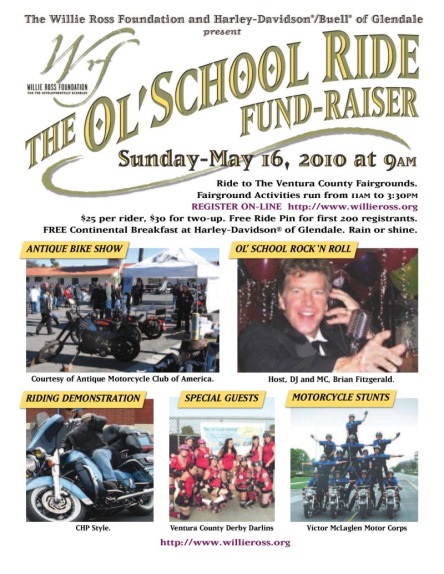
Master (Maestro) Paul H. Borisoff played a major role in producing a fund-raiser for the Willie Ross Foundation. Despite the Tujunga Fires, the show went on bringing badly needed funds to the foundation! Kung-Fu San Soo, Reseda's students, past and present, rallied to help out.
(Click above to enlarge)